


Wikipedia:Today's featured article/April 2026
| << | Today's featured articles for April 2026 | >> | ||||
|---|---|---|---|---|---|---|
| Su | Mo | Tu | We | Th | Fr | Sa |
| 1 | 2 | 3 | 4 | |||
| 5 | 6 | 7 | 8 | 9 | 10 | 11 |
| 12 | 13 | 14 | 15 | 16 | 17 | 18 |
| 19 | 20 | 21 | 22 | 23 | 24 | 25 |
| 26 | 27 | 28 | 29 | 30 | ||
April 1
.jpg/250px-Nathaniel_Bentley_Sketch_(cropped).jpg)
Dirty Dick, real name Nathaniel Bentley (c. 1735 – 1809), was an English merchant known for his filthy appearance. Once nicknamed "the beau of Leadenhall Street", in his late thirties Bentley became parsimonious and stopped cleaning himself and his shop. He and his shop became well known and were lampooned in the press. People visited the outlet to see the squalor and noted that he was polite and had impeccable manners. Rumours circulated that he had not washed since his fiancée had died on their wedding eve and that he had locked the dining room, complete with the wedding feast, and left it to moulder. Bentley moved out of his shop in 1804 and its contents were sold off. A publican purchased some of the contents, including mummified rats and cats, and used them to decorate his pub, which he renamed Dirty Dicks. Bentley died in Scotland. His story was known by the writer Charles Dickens, and Bentley's locked dining room may have inspired the locked room of Miss Havisham in Great Expectations. (Full article...)
April 2

The pied butcherbird (Cracticus nigrogularis) is a songbird native to Australia. Described by John Gould in 1837, it is 28 to 32 cm (11 to 12.5 in) long. It has a pale hooked bill and a black head, throat and mantle. Much of the tail and wings is also black, and the neck, underparts and outer wing feathers are white. The juvenile and immature birds are predominantly brown and white. There are two recognised subspecies. Within its large range, the pied butcherbird is generally non-migratory. Common in woodlands and in urban environments, it is carnivorous, eating insects and small vertebrates, including birds. A tame and inquisitive bird, the pied butcherbird has been known to accept food from humans. It nests in trees, constructing a cup-shaped structure out of sticks and laying two to five eggs. Some mated pairs benefit from cooperative breeding, in which other birds help feed the young and defend the nest. (Full article...)
April 3
Three Studies for Figures at the Base of a Crucifixion is a 1944 triptych painted by Francis Bacon. The canvasses are based on the Eumenides—or Furies—of Aeschylus's Oresteia and depict three writhing anthropomorphic creatures set against a flat burnt orange background. It was executed in oil paint and pastel on fibreboard and completed within two weeks. The triptych summarises themes explored in Bacon's previous work, including his examination of Picasso's biomorphs and his interpretations of the Crucifixion and the Greek Furies. Bacon did not realise his original intention to paint a large crucifixion scene and place the figures at the foot of the cross. The Three Studies are generally considered Bacon's first mature piece; he regarded his works before the triptych as irrelevant, and throughout his life he tried to suppress their appearance in the art market. When the painting was first exhibited in 1945, it caused a sensation and established him as one of the foremost post-war painters. (Full article...)
April 4

Apollo 6 (flown April 4, 1968) was the third and final uncrewed flight in the United States' Apollo program and the second test of the Saturn V launch vehicle. Apollo 6 was intended to show that the Saturn V's third stage, the S-IVB, could propel itself and the Apollo spacecraft to lunar distances. Once components arrived at Kennedy Space Center, testing proceeded slowly, often delayed by testing of the Saturn V intended for Apollo 4, but once that launched, there were fewer delays. NASA planned a flight of about ten hours, but during launch (pictured) vibrations damaged some of the Rocketdyne J-2 engines, and the resulting parking orbit was more elliptical than planned. The third-stage engine failed to restart, and flight controllers elected to repeat the flight profile of Apollo 4, achieving a high orbit and high-speed return. Despite the engine failures, the flight qualified the Saturn V for crewed launches, and it was first used for crewed flight in December 1968 with Apollo 8. (Full article...)
April 5
.jpg)
The Easter Oratorio, BWV 249, is one of three oratorios composed by Johann Sebastian Bach for high holiday services of the Lutheran church in Leipzig. He wrote an autograph score (page pictured) in 1738, but had already composed the music in 1725 for two works: the congratulatory Shepherd Cantata and a church cantata for Easter. The text of the Shepherd Cantata was written by Picander, in his first documented collaboration with Bach. Picander may also have adapted the text for the Easter work, using unusually neither Biblical text nor chorales. Both works are musical dramas involving male and female characters, which, in the cantata, are from the Biblical Easter narratives. The music is structured in eleven movements, and scored for a festive Baroque instrumental ensemble of three trumpets, timpani, a variety of wind instruments, strings and continuo. Bach performed the Easter Oratorio in 1749, the year before his death. (Full article...)
April 6
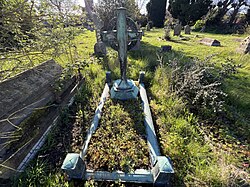
The Duffield Memorial is a gravesite monument located in the churchyard of the Church of St Mary in Great Baddow, England. Designed by Herbert Maryon and installed in 1912, it commemorates Marianne and W. W. Duffield, who died in 1910 and 1912, respectively. A second plaque commemorates their son, W. B. Duffield, who died in 1918. The memorial is made of riveted sections of bronze sheet metal and comprises edging and a vertical cross. The edging follows the rectangular perimeter of the grave plot, with short pillars at each corner. Within the plot sits a Celtic wheel cross, decorated in relief with leaflike motifs. A curved shaft connects it to the foot; both the shaft and the four-sided base upon which it is mounted have curved and splayed sides. The plaques commemorating the Duffields are riveted to the base; a medallion, now lost, was once riveted to the centre of the cross. In 2022, Historic England designated the work a Grade II listed building, noting its unusual Art Nouveau metalwork. (Full article...)
April 7

Interstate 205 (I-205) is an Interstate Highway in the Portland metropolitan area of Oregon and Washington, United States. The north–south freeway is 37 miles (60 km) long and serves as a bypass route for I-5 east of Portland. Such a highway was conceived in 1943 plan for the area, and in the 1950s was included in preliminary plans for the Interstate Highway System. Construction began in 1967 with work on the Abernethy Bridge over the Willamette River, which opened in 1970. By 1972, I-205 was extended west to Tualatin and north to Gladstone but the Portland section was delayed by political opposition until 1977. The Glenn L. Jackson Memorial Bridge, spanning the Columbia River between Portland and Vancouver, opened on December 15, 1982. The remaining 6.6 miles (10.6 km) in Portland opened on March 8, 1983. From Oregon City to Vancouver, the corridor is paralleled by a multi-use bicycle and pedestrian trail, as well as portions of the MAX Light Rail system. (Full article...)
April 8

Mališan was a CB-class midget submarine that served in the Yugoslav Navy (JRM) from 1953 to 1957. Laid down for the Italian Navy during World War Two, she was intended for harbour defence and anti-submarine warfare tasks, but was incomplete at the time of the Italian surrender in September 1943. The unfinished boat was captured by the Germans and completed by March 1944. Handed over to the navy of the Italian Social Republic – a wartime German puppet state – she was captured by Yugoslav forces at the end of the war. She was repaired and commissioned in a training role by the JRM. She was donated to the Technical Museum in Zagreb in 1959 as a museum ship, and was on display for almost 50 years before undergoing an extensive restoration between 2008 and 2010. The restored submarine returned to public display on 8 April 2010. The decision to revert to its original Italian paint scheme and designation as part of the restoration has been criticised. (Full article...)
April 9
.jpg/250px-Solidus_of_Theophilos_sb1653_(reverse).jpg)
Constantine (820s or 830s – before 836) was an infant prince of the Amorian dynasty who briefly ruled as co-emperor of the Byzantine Empire sometime in the 830s, alongside his father Theophilos. He was born to Theophilos and his wife, Empress Theodora. When naming Constantine, his father defied standard naming conventions, as his son was not named after his father Michael II. Most information about Constantine's short life and titular reign is unclear, although it is known that he was born sometime in the 820s or 830s and was installed as co-emperor soon after his birth. He appears on the coinage issued under his father, albeit addressed as despot (not a formal title, but an honorific interchangeable with basileus, i.e. emperor) on gold coins, but with no title at all on bronze ones. He died sometime before 836, possibly after falling into a palace cistern. His parents buried him in a sarcophagus made of Thessalian marble in the Church of the Holy Apostles. (Full article...)
April 10
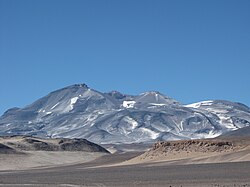
Ojos del Salado is a dormant complex volcano in the Andes on the Argentina–Chile border. It is the highest volcano on Earth and the highest peak in Chile. The complex extends over an area of 70–160 square kilometres (27–62 sq mi) and its highest summit reaches an altitude of 6,893 metres (22,615 ft) above sea level. The mountain has extremely dry conditions, which prevent the formation of substantial glaciers and a permanent snow cover. Despite the arid climate, there is a permanent crater lake about 100 m (330 ft) in diameter at an elevation of 6,480 metres (21,260 ft)-6,500 metres (21,300 ft) within the summit crater and east of the main summit. This is the highest lake of any kind in the world. An international highway between Argentina and Chile crosses north of the mountain. During the middle of the 20th century there was a debate on whether Ojos del Salado or Aconcagua was the highest mountain in South America which was eventually resolved in favour of Aconcagua. (Full article...)
April 11

On 11 April 1951, Douglas MacArthur was relieved of command by U.S. President Harry S. Truman (both pictured) after General of the Army MacArthur made statements that contradicted the administration's policies. MacArthur was a popular hero of World War II and his relief remains a controversial topic in civil–military relations. After North Korea invaded South Korea in June 1950, starting the Korean War, MacArthur won the Battle of Inchon, but the following invasion of North Korea on Truman's orders led to China inflicting a series of defeats. MacArthur was compelled to withdraw from North Korea and after the military situation had stabilized, Truman relieved him. This created a constitutional crisis. The United States Senate held an inquiry into the military situation and the circumstances surrounding MacArthur's relief, and concluded that "the removal of General MacArthur was within the constitutional powers of the President but the circumstances were a shock to national pride". (Full article...)
April 12
_at_All/250px-Grave_of_Henry_Joseph_Darger_(1892%e2%80%931973)_at_All_Saints_Cemetery%2c_Des_Plaines.9d82.delaye)
Henry Darger (April 12, 1892 – April 13, 1973) was an American who became known after his death for his immense body of art and literature. Born in Chicago, Darger's mother died when he was young, and he was placed in a boys' home after his father's health declined. He was taken to a children's asylum in 1904, escaping six years later. He lived in poverty, doing menial work at various hospitals. When he was moved to a nursing home in 1972, his landlords Kiyoko and Nathan Lerner discovered his artwork and writing, popularizing it themselves. His work included a 15,145-page novel entitled In The Realms of the Unreal, centered on a rebellion of child slaves on a fantastical planet, and hundreds of watercolor and collage illustrations, using traced material from popular media. Often classified as an outsider artist for his secrecy, his work contains Catholic themes, graphic depictions of war and the killing of children, and many naked girls with penises, leading to debate on his mental state. (Full article...)
April 13

The Yuan Shikai coinage, designed by Tianjin Mint engraver Luigi Giorgi and struck starting in 1914, was struck by the Republic of China to replace imperial and foreign coins in circulation. They depict Yuan Shikai on the obverse (shown), and on the reverse, a wreath of grain and the denomination of one yuan. Coins were produced by mints across China. Until 1920, all coins were dated Republican Year 3 (1914 CE) regardless of when they were struck. The Nationalist government ordered an end to its production in 1929, but striking continued, with poorer-quality examples produced in Communist-held areas during the 1930s. Later issues were in response to hyperinflation during the Chinese Civil War, including a large run of coins at Canton in 1949. Thet were struck again in the mid-1950s for use in newly annexed Tibet and rural southwestern China. In total, around 1.1 billion Yuan Shikai dollars were produced from 1914 to 1954, not including local issues produced by warlords or revolutionaries. (Full article...)
April 14

Flow is a video game created by Jenova Chen (pictured) and Nicholas Clark. Released as a Flash game in 2006 to accompany Chen's master's thesis, it was reworked into a PlayStation 3 game by Thatgamecompany, with assistance from Santa Monica Studio. In Flow, the player navigates a series of two-dimensional planes with an aquatic microorganism that evolves by consuming other microorganisms. The game's design is based on Chen's research into dynamic difficulty adjustment and on Mihaly Csikszentmihalyi's theoretical concept of flow. The Flash version of the game had 100,000 downloads within its first two weeks of release and was played over 3.5 million times by 2008. Its PlayStation 3 re-release was the most downloaded game on the PlayStation Network in 2007 and won the Best Downloadable Game award at the 2008 Game Developers Choice Awards. Reviewers praised Flow's visual and audio appeal, but noted the simplicity of its gameplay; several considered it to be more of an art piece than a game. (Full article...)
April 15
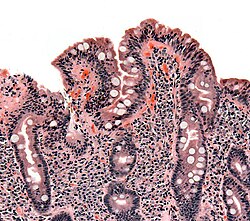
Coeliac disease is a chronic autoimmune disease mainly affecting the small intestine, caused by an abnormal immune system response to gluten. The disease's classic form can affect any age group, causing symptoms of malabsorption. Non-classic coeliac disease is more common in adults, characterised by vague abdominal symptoms and complications in organs outside the gastrointestinal tract. To those with a genetic predisposition to the condition, eating gluten causes inflammation in the small intestine, damaging its lining and leading to malabsorption. Diagnosis is based on symptoms, blood tests, and biopsies of the small intestine. It is treated by implementing a gluten-free diet; symptoms can improve within days. Diagnoses have increased due to increased awareness and availability of blood testing, but it is still thought to be underdiagnosed. Most people develop the disease before the age of 10; it is slightly more common in women than in men. (Full article...)
April 16
.jpg/120px-Statue_of_Ninetjer_Rijksmuseum_van_Oudheden_03_(cropped).jpg)
Nynetjer was the third pharaoh of the Second Dynasty of Egypt. Egyptologists proposed that his reign happened between the late 29th and early 27th century BC and probably lasted around 40 years. Archaeologically, Nynetjer is the best-attested king of the early Second Dynasty. Most events recorded for his reign on the Palermo Stone are religious festivals and censuses. The probable locations for these events indicate that royal activity was largely confined to the capital Memphis and its vicinity in Lower Egypt. The administrative partition of Egypt into nomes happened during his reign. Nynetjer had a large gallery tomb dug for himself in Saqqara comprised of over 150 rooms, some arranged to model a royal palace. When excavated, the tomb housed funerary equipment and stone tools, some of which were used in a ritual feast for Nynetjer's burial. The subterranean tomb was probably built with associated superstructures but these were levelled and overbuilt by subsequent pharaohs. (Full article...)
April 17
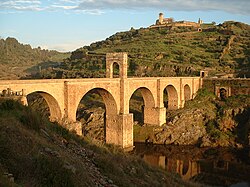
A bridge is a structure designed to span an obstacle, such as a river or valley, allowing vehicles, pedestrians, and other loads to pass across. Simple bridge structures include beam bridges made from logs, and suspension bridges made of ropes or vines. The Romans and ancient Chinese built major arch bridges of timber, stone, and brick. The longest spans use suspension or cable-stayed designs. Bridge design is an important discipline within the field of civil engineering. A bridge must be strong enough to support its own weight as well as the weight of the traffic passing over it. It must also tolerate violent, unpredictable stresses imposed by the environment, including winds, floods, and earthquakes. Many bridges are admired for their beauty, and some spectacular bridges serve as iconic landmarks that provide a sense of pride and identity for the local community. In art and literature, bridges are frequently used as metaphors to represent connection or transition. (Full article...)
April 18

Tropical Storm Henri was a moderate tropical storm that struck Florida during the 2003 Atlantic hurricane season. The eighth storm of the season, Henri formed from a tropical wave in the Gulf of Mexico on September 3. Moving generally to the east, it strengthened to peak winds of 60 mph (97 km/h) two days later. Henri weakened to a tropical depression before making landfall near Clearwater, Florida, dropping heavy rainfall with minor flooding damage. Henri degenerated into a remnant low on September 8 and persisted off the east coast of the United States for a few days before moving back ashore over North Carolina. The system brought heavy rainfall across parts of the Mid-Atlantic before dissipating on September 17. In Delaware and Pennsylvania heavy rainfall damaged hundreds of houses and businesses. The resulting floods in Delaware were described as a 1 in 500 year event. The total damage by Henri along its path amounted to $19.6 million, but no deaths were reported. (Full article...)
April 19
.jpg/250px-Joe_Johnson_(snooker_player%2c_1988).jpg)
The 1986 World Snooker Championship was a professional snooker tournament which took place between 19 April and 5 May 1986 at the Crucible Theatre in Sheffield, England. It was the sixth and final ranking event of the 1985–86 snooker season and the 1986 edition of the World Snooker Championship, which was first held in 1927. The total prize fund was £350,000 with £70,000 awarded to the winner. The defending champion was Dennis Taylor, who had defeated Steve Davis 18–17 in the 1985 World Snooker Championship final to win his first world title. Taylor lost in the first round of the 1986 event 6–10 to Mike Hallett. The world number 16 Joe Johnson (pictured) defeated Davis 18–12 in the final to win his sole ranking event. Prior to the competition, the bookmakers' odds for a Johnson victory were 150/1. There were 20 century breaks compiled in total during the tournament, the highest of which was a 134 made by Davis. (Full article...)
April 20

The Sci-Fi Dine-In Theater Restaurant is a theme restaurant at Disney's Hollywood Studios, a theme park at Walt Disney World in Bay Lake, Florida. The restaurant is modeled after a 1950s drive-in theater. Walt Disney Imagineering designed the booths to resemble convertibles of the period. While eating, guests watch a large projection screen displaying clips from films such as Frankenstein Meets the Space Monster, Plan 9 from Outer Space, and Attack of the 50 Foot Woman. In 1991, the Sci-Fi Dine-In opened along with nineteen other new Walt Disney World attractions marking the complex's twentieth anniversary. By the following year, it had become the park's most popular restaurant. Thai movie theater operator EGV Entertainment opened the EGV Drive-in Cafe in Bangkok in 2003, explicitly emulating the Sci-Fi Dine-In. USA Today's list of the best restaurants in American amusement parks ranks the Sci-Fi Dine-In fifteenth, but many reviewers rate it more highly for its atmosphere than its cuisine. (Full article...)
April 21

"Sinestro Corps War" is an American comic book crossover event published by DC Comics in its Green Lantern and Green Lantern Corps titles. Written by Geoff Johns (pictured) and Dave Gibbons and drawn by Ivan Reis, Patrick Gleason, and Ethan Van Sciver, the 11-part saga was published between June and December 2007 with a main storyline, four supplemental "Tales of the Sinestro Corps" one-shot specials and a Blue Beetle tie-in issue concurrently released. The story centers on the Green Lantern Corps' interstellar war against the Sinestro Corps, led by Sinestro, who seek a universe ruled through fear. The 1986 "Tales of the Green Lantern Corps" story was the thematic basis of the storyline. Critical and fan reception to "Sinestro Corps War" was positive. Many reviewers ranked it among the top comic books of the year and the storyline's first issue garnered a 2008 Eisner Award nomination. The storyline was a financial success and several issues underwent multiple printings. (Full article...)
April 22

Nihilism is a family of philosophical views. Existential nihilism asserts that life is inherently meaningless and lacks a higher purpose, suggesting that all individual and societal achievements are ultimately pointless. Moral nihilism denies the objective existence of morality, arguing that moral evaluations and practices rest on misguided assumptions without any foundation in external reality. Epistemological forms of nihilism challenge objective knowledge and truth. Some versions argue that these phenomena are relative to the perspectives of individuals or cultural contexts while others deny their existence altogether. Cosmological nihilism is the view that reality is unintelligible and indifferent to human understanding. Metaphysical nihilism holds that there is no fundamental reason for why something exists rather than nothing. Nihilism is also described as a broad cultural phenomenon or historical movement that pervades modernity in the Western world. (Full article...)
April 23

Beyoncé (born 1981) is an American singer, songwriter, actress, and businesswoman. She rose to fame in the late 1990s as the lead vocalist of Destiny's Child, one of the best-selling girl groups. Beyoncé then embarked on a successful solo career, releasing eight chart-topping studio albums—from Dangerously in Love (2003) to Cowboy Carter (2024)—and becoming one of the best-selling musicians in history. She has nine US Billboard Hot 100 number-one singles, including "Crazy in Love", "Irreplaceable", "Single Ladies (Put a Ring on It)", "Break My Soul", and "Texas Hold 'Em". Her accolades include a record 35 Grammy Awards, a Primetime Emmy Award, and a Peabody Award. A cultural icon spanning three decades, Beyoncé was named by Billboard as the greatest pop star of the 21st century and by Rolling Stone as the eighth-greatest singer of all time. Her business endeavors include the nonprofit BeyGood, the hair care brand Cécred, the whiskey SirDavis, and Parkwood Entertainment. (Full article...)
April 24

Ornithoprion is an extinct genus of cartilaginous fish. Its only species lived during the Moscovian age. Its fossils are preserved in black shales from the Midwestern United States. Ornithoprion's genus name, which may be translated from Greek as 'bird saw', was inspired by the animal's bird-like skull and the saw-like appearance of the teeth in the lower jaw. The specific name honors German zoologist Oscar Hertwig. Ornithoprion had a unique projection of its lower jaw termed the mandibular rostrum, which was covered by a beak of fused bony scales. It inhabited shallow, seasonal marine and brackish water environments. The rounded shape of Ornithoprion's teeth suggests that it hunted hard-shelled invertebrates, and bite marks and damage to some of its fossils indicate that it was fed on by other carnivores. Ornithoprion was small relative to other members of its order, with a cranium length of up to 10 cm (3.9 in) and an estimated body length of up to approximately 91 cm (36 in). (Full article...)
April 25
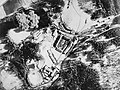
The bombing of Obersalzberg was a air raid carried out by 359 Allied heavy bombers on 25 April 1945 during the last days of the European theatre of World War II. The operation targeted a complex of residences and bunkers built for Adolf Hitler at Obersalzberg, Bavaria, from which the Allies feared that the German Government would command an Alpine Fortress. Many buildings were destroyed, though Hitler's residence and the bunker network were only slightly damaged. Hitler was not present. Two Allied bombers were shot down with the loss of four airmen, and 31 Germans were killed. Historians have identified several motives for the attack, including supporting Allied ground forces, demonstrating the effectiveness of the heavy bomber, convincing die-hard Germans that the war was lost and obscuring the memory of pre-war appeasement policies. The raid was celebrated at the time, but as the Alpine Fortress proved to be a myth most post-war histories made little mention of the operation. (Full article...)
April 26
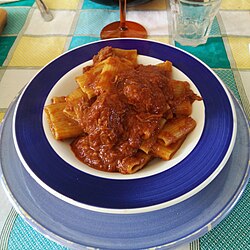
Neapolitan ragù is a ragù associated with Naples, Italy, made by browning then braising meat over several hours in tomato purée and sauce. The meat is then removed and the sauce is left to continue cooking and thickening. The dish is served in two stages: first as sauce served over pasta, then as meat eaten alone or with vegetables, lightly dressed with the remaining sauce. The people of Naples hold their version in high regard, calling it rraù. Writers from the area describe it as the "queen of sauces". Although it contains tomato and meat, it is perceived to be a meat sauce, with the tomato as a conduit for meat flavours. Neapolitan ragù evolved from the French ragoût, introduced to Italy in the late 17th century. Ingredients foreign to the modern ragù, such as asparagus and truffle, were dropped while tomatoes and pasta were added. In the 19th century, emigrants brought the dish to America, where it was developed into the Italian-American gravy and the dish spaghetti and meatballs. (Full article...)
April 27
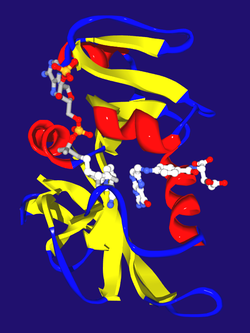
Enzyme kinetics is the study of the rates of enzyme-catalysed chemical reactions where the reaction rate is measured and the effects of varying the conditions of the reaction are investigated. The study of an enzyme's kinetics can reveal the catalytic mechanism of the enzyme, its role in metabolism, how its activity is controlled, and how a modifier might affect the rate. Some enzymes change shape significantly during the mechanism; in such cases, it is helpful to determine the enzyme structure with and without bound substrate analogues that do not undergo the enzymatic reaction. When enzymes bind multiple substrates, enzyme kinetics can show the sequence in which these substrates bind and determine the sequence in which products are released. There is typically one rate-determining step that determines the overall kinetics, which may be a chemical reaction or a conformational change of the enzyme or substrates. (Full article...)
April 28

This Side of the Moon is the third studio album by American singer Elizabeth Cook, released on May 17, 2005, by Hog Country Production. A country album, This Side of the Moon features lyrics about love and heartbreak. Cook based the album on her poor experience with Warner Bros., the record label which had released her unsuccessful second studio album, Hey Y'all, in 2002, after a delay. Most of the songs on This Side of the Moon were written by Cook and songwriter Hardie McGehee, working for Sis 'N Bro Music. Critics likened Cook's vocals to those of country artists such as Loretta Lynn and Dolly Parton. This Side of the Moon had a limited release in August 2004 before becoming more widely available the following year. The album received little airplay and, after its release, Cook worked as a waitress to secure steady pay. Critical response at the time was generally positive and, in retrospective articles, reviewers felt This Side of the Moon helped enhance Cook's musical career. (Full article...)
April 29

During the 1998–99 English football season, Gillingham F.C. competed in the Football League Second Division, the third tier of the English football league system. It was the 67th season in which Gillingham competed in the Football League, and the 49th since the club was voted back into the league in 1950. The club signed two new forwards, each for a new club record transfer fee, but started the season in poor form, winning only one of the first eight league games. The team then went on a much-improved run, being undefeated for 17 league games, and began challenging for promotion to the Football League First Division. Gillingham finished the regular season in fourth place in the Second Division, qualifying for the play-offs for promotion to the First Division. After defeating Preston North End in the semi-finals, they played Manchester City at Wembley Stadium in the final, which Manchester City won the subsequent penalty shoot-out to gain promotion. (Full article...)
April 30

330 West 42nd Street, also known as the McGraw-Hill Building, is a a 485-foot-tall (148 m), 33-story skyscraper in the Hell's Kitchen neighborhood of Manhattan in New York City, New York, U.S., designed by Raymond Hood and J. André Fouilhoux in a mixture of the International Style, Art Deco, and Streamline Moderne. The building was constructed from 1930 to 1931 and originally served as the headquarters of the McGraw-Hill Companies, who moved away in 1972. It was vacant for three years, then became the headquarters of Group Health Insurance. Since then, ownership of 330 West 42nd Street has changed several times. Deco Towers, which has owned the building since 1994, began considering converting it into condominiums in 2018. Moed de Armas and Shannon completely renovated the building (including the lobby) in 2021, and the upper stories were converted into apartments starting in 2023. Designated as a city landmark, the building is listed on the National Register of Historic Places. (Full article...)