


Prime Minister of Mongolia
| Prime Minister of Mongolia | |
|---|---|
| Монгол Улсын Ерөнхий сайд (Mongolian) | |
 | |
 | |
| Executive branch of Mongolia | |
| Type | Head of government |
| Member of | National Security Council |
| Seat | Government Palace, Ulaanbaatar |
| Nominator | President |
| Appointer | State Great Khural |
| Term length | 4 years; renewable |
| Constituting instrument | Constitution of Mongolia |
| Precursor | Prime Minister of the Mongolian People's Republic |
| Formation | November 1912 11 September 1990 |
| First holder | Tögs-Ochiryn Namnansüren (1912) Dashiin Byambasüren (1990) |
| Deputy | First Deputy Prime Minister of Mongolia |
| Salary | ₮62,102,880 / US$18,393 annually (2024)[1][2][3] |
 |
|---|
 Politics portal Politics portal |


.svg/40px-Emblem_of_the_Government_of_Mongolia_(mon).svg.png)


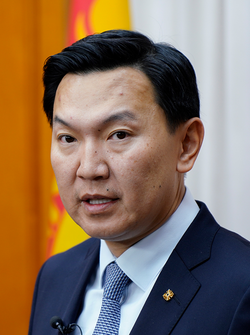
The prime minister of Mongolia[a] is the head of government of Mongolia. Under the Constitution of Mongolia, the State Great Khural appoints the Prime Minister upon the President’s submission of a candidate nominated by the parliamentary majority.[4] The Prime Minister shall be dismissed if no fewer than one-fourth of the members of the State Great Khural formally submit a proposal for the Prime Minister’s dismissal and a majority of all members approve it,[5] or if a resolution expressing confidence in the Prime Minister is not adopted.[6] The incumbent prime minister is Nyam-Osoryn Uchral, who succeeded Gombojavyn Zandanshatar on 31 March 2026, following his resignation four days earlier.[7]
Roles and responsibilities
[edit]The prime minister holds the authority to hire and dismiss Cabinet ministers[8] and is responsible for appointing the governors of the 21 aimags of Mongolia, as well as the governor of the capital, Ulaanbaatar.[9] Additionally, the Prime Minister plays a crucial role in shaping domestic policy and directing the government’s legislative agenda.[10] The appointment of key figures in the government, such as the head of various state agencies and ministries, also falls within the Prime Minister’s scope of influence.[11]
In the case of political reforms, the prime minister's decisions can significantly impact governance structures at both the national and provincial levels, reflecting the centralization of executive power within Mongolia's political system.[12] This concentration of authority can, at times, lead to calls for decentralization, as various political actors advocate for more autonomy in decision-making at the regional level.[13]
History
[edit]The office of prime minister was established by the Bogd Khanate of Mongolia in 1912, shortly after Outer Mongolia first declared independence from the Manchu Qing dynasty. This was not recognized by many nations in the 1910s. By the time of Mongolia's second (and more generally recognized) declaration of independence from the occupation by Beiyang China in 1921, the office was controlled by a communist group known as the time Mongolian People's Revolutionary Party. 1924 the party established the Mongolian People's Republic, and the prime minister's post was superseded by one known by the chairman of the council of people's commissars. This was changed to chairman of the council of ministers in 1946. The title of prime minister was only revived in 1990, when the People's Revolutionary Party gradually released its hold on power. Regardless of the changes of name, however, the modern Mongolian government recognizes the office as having existed continuously since 1912, and counts all holders of the office as prime ministers.[14]
There is some confusion as to the first holder of the office. A lama named Tseren (or Tserenchimed) held office as "prime minister" (actually the Interior minister) during a provisional government, and is sometimes cited as the first holder of the modern office. However, the Mongolian government considers Tögs-Ochiryn Namnansüren, the first formal office-holder, to be the first.[15] There is also some confusion over the status of Tsengeltiin Jigjidjav, some consider him to have only been acting Prime Minister, while some consider him to have been a full Prime Minister. The Mongolian government takes the latter view.[16]
See also
[edit]Notes
[edit]- ^
- Mongolian: Монгол Улсын Ерөнхий Сайд, romanized: Mongol Ulsiin Yörönkhii Said, pronounced [mɔ́ɴɢəɮ ʊɮsíːɴ jɵrəŋxíː sɛ́ːt]
- In the Mongolian script: ᠮᠣᠩᠭᠣᠯ ᠤᠯᠤᠰ ᠤᠨ ᠶᠡᠷᠦᠩᠬᠡᠢ ᠰᠠᠶᠢᠳ
References
[edit]- ^ REGARDING THE UPDATE OF THE SALARY RANGE AND MINIMUM RANGE OF CERTAIN CIVIL OFFICES (Government Resolution.128, Appendix 2). Government of Mongolia. 2024-03-27.
- ^ ABOUT THE APPROVAL OF THE COEFFICIENT FOR DETERMINING THE SALARY (State Great Khural Resolution.63, Appendix. List item No.2). State Great Khural. 2019-06-06.
- ^ REGARDING DETERMINATION OF SENIOR STATE OFFICIAL RANK AND EQUIVALENT CIVIL OFFICE RANK (State Great Khural Resolution.19, Appendix). State Great Khural. 2019-02-01.
- ^ Article 39, Clause 2, Constitution of Mongolia, 1992
- ^ Article 43, Clause 1, Constitution of Mongolia, 1992
- ^ Article 44, Clause 2, Constitution of Mongolia, 1992
- ^ Edwards, Terrence Matthew (2026-03-30). "Mongolia Appoints Uchral as Third Prime Minister Within a Year". Bloomberg. Retrieved 2026-03-31.
- ^ Adiya, Amar (2022-05-03). "Mongolia Considers Major Political Reforms". Mongolia Weekly. Retrieved 2022-09-11.
- ^ Montsame News Agency. Mongolia. 2006, Foreign Service Office of Montsame News Agency, ISBN 99929-0-627-8, p. 47
- ^ Narankhuyag, Ganbat (2021-03-22). "Political System and Leadership in Mongolia". Mongolian Policy Forum. Retrieved 2022-09-11.
- ^ Bayar, Jargal (2020-11-14). "Governance and Institutional Structures in Mongolia". Mongolian Governance Forum. Retrieved 2022-09-11.
- ^ Chuluun, Tseren (2019-06-10). "Mongolian Political Reforms and Challenges". Mongolian Reform Review. Retrieved 2022-09-11.
- ^ Ganbold, Baatar (2020-09-05). "Decentralization and Regional Governance in Mongolia". Mongolia Decentralization Blog. Retrieved 2022-09-11.
- ^ Sureyya, Yigit (August 2021). "Mongolia's Historic Relations with its Largest Neighbour: Russia". Electronic Journal of Social and Strategic Studies. 2 (IV): 9–41.
- ^ Gareth, Harris (29 December 2023). "Mongolia mulls restitution claims after identifying objects held abroad". The Art Newspaper. Retrieved 29 December 2023.
These include a letter from around 1921 written by the first prime minister of Mongolia, Tögs-Ochiryn Namnansüren, declaring the country's independence from China's Manchu Dynasty, at present held at the British Library in London. The library says it has not received any enquiries regarding this item to date.
- ^ "China/Mongolia (1911-1946)". University of Central Arkansas. Department of Government, Public Service, and International Studies. Retrieved 2024-02-14.
Prime Minister Tsengeltiin Jigjidjav resigned on July 2, 1932, and Peljidiin Genden was appointed as prime minister.
External links
[edit]- Official website of the Mongolian government (in Mongolian)
 Bogd Khanate of Mongolia Bogd Khanate of Mongolia(1911–1919, 1921–1924) | |
|---|---|
.svg/40px-Flag_of_the_Mongolian_People%27s_Republic_(1945%e2%80%931992).svg.png) Mongolian People's Republic Mongolian People's Republic(1924–1992) | |
 Mongolia Mongolia(1992–present) | |
| |