


2026 in science
| List of years in science |
|---|
| (table) |
The following scientific events occurred, or are scheduled to occur in 2026.
Events
[edit]January
[edit]- 1 January
- Researchers operating China's Experimental Advanced Superconducting Tokamak (EAST) report the first experimental verification of a theorised density-free plasma operating regime, achieving stable electron densities approximately 1.3–1.65 times the Greenwald limit.[1][2]
- Researchers at the Korea Advanced Institute of Science and Technology report a photo-Hall (Hall effect)–based method for detecting semiconductor electronic trap states with approximately 1,000-fold greater sensitivity than existing techniques.[3][4]
- 2 January – Researchers at the Vienna University of Technology and the Okinawa Institute of Science and Technology demonstrate self-sustained superradiant microwave emission, produced by interacting spins in diamond, offering potential applications in quantum communication and sensing.[5][6]
- 4–8 January – 247th Meeting of the American Astronomical Society[7]
- 5 January – NASA announces that it has awarded contracts to seven companies to study technologies for the Habitable Worlds Observatory, a next-generation telescope that could launch in the 2040s.[8][9]
- 7 January – Astronomers using data from the Vera C. Rubin Observatory report that 2025 MN45 has the fastest spin of any known asteroid larger than 0.5 km (0.31 mi) in diameter, completing one rotation every 1.88 minutes.[10]
- 13 January
- The European Copernicus Climate Change Service reports that 2025 was the world's third hottest year on record (2024 was the hottest and 2023 the second hottest). In Antarctica, the average annual temperature was the warmest since measurements began and in the Arctic, it was the second highest.[11]
- Paleoanthropologists publish a complete analysis of KNM-ER 64061, the most complete known skeleton of Homo habilis, discovered in 2012 in Kenya.[12][13][14]
- 14 January
- Researchers report the discovery of a new quantum state, bridging the gap between quantum criticality and quantum topology via semimetal CeRu4Sn6.[15]
- Researchers led by the University of the Chinese Academy of Sciences report the first direct experimental observation of the Migdal effect, a quantum process in which a recoiling atomic nucleus ejects an electron, confirming a prediction made in 1939 and enabling new approaches to searches for light dark matter.[16][17]
- Researchers from the University of Copenhagen publish a Nature paper explaining little red dots as young and relatively small supermassive black holes enshrouded in a dense cocoon of ionized gas.[18][19]
- The Ice Memory Foundation opens its ice core archive at Concordia Station in Antarctica, storing the first samples from glaciers on Grand Combin, Switzerland and Mont Blanc, France.[20][21][22][23] The samples travelled from Trieste for more than 50 days aboard the Italian icebreaker Laura Bassi.[24]
- 19 January
- The first known example of multi-purpose tool use by a cow is reported, with a Brown Swiss named Veronika using both ends of a stick to scratch her own back.[25][26]
- Researchers at the University of California, Davis, develop a machine learning-augmented spectrometer-on-a-chip capable of real-time hyperspectral sensing across the visible and near-infrared range, enabling compact alternatives to conventional laboratory spectrometers.[27][28]
- 23 January – The largest interstellar organosulfur molecule (2,5-cyclohexadiene-1-thione) so far is identified in a molecular cloud about 27,000 light-years from Earth near the Galactic Center.[29][30]
- 24 January – AES Andes abandons the INNA project to produce hydrogen and ammonia in Chile criticised for its potentially negative impact on astronomical observations at Paranal Observatory and Extremely Large Telescope.[31][32][33]
- 27 January – HD 137010 b, a cool Earth-sized transiting exoplanet candidate 146 light years away, orbiting near the outer edge of its star's habitable zone, is discovered in Kepler K2 data from 2017.[34][35]
- 28 January – Researchers at Google DeepMind publish a study on AlphaGenome, a deep learning model that predicts the functional effects of genetic variants across multiple regulatory modalities from long DNA sequences, improving interpretation of non-coding regions of the genome.[36][37]
February
[edit]- 12 February
- Using observations by ESA's CHEOPS telescope, scientists describe a unique configuration of a planetary system around the star LHS 1903, where the innermost and outermost planets are rocky, while the two middle planets have extended atmospheres. This provides support for the "inside-out" model of planet formation.[38][39][40][41]
- A small polymerase ribozyme is described which can synthesize both its complementary strand and a copy of itself. This is interpreted as a substantial support for the "RNA world" hypothesis of the origin of life.[42][43]
- Researchers at Iceberg Quantum publish a study describing the "Pinnacle Architecture", a fault-tolerant quantum computing design based on quantum low-density parity-check (qLDPC) codes. They show that a 2048-bit RSA integer could be factored with fewer than 100,000 physical qubits under standard hardware assumptions – an order-of-magnitude reduction compared to previous estimates.[44][45]
- 24 February – Researchers in Switzerland report that centenarians show "youthful" blood profiles across 37 proteins, including markedly lower oxidative stress markers, suggesting that specific aging-related biological pathways are slowed in exceptional longevity.[46]
- 26 February – Researchers in Australia report that serum bicarbonate levels in U.S. population data have risen by 7% since 1999, tracking increases in atmospheric carbon dioxide. Modelling suggests that, if current trends continue, average bicarbonate levels could approach the upper limit of today's accepted healthy range within 50 years.[47][48]
March
[edit]- 6 March
- Astronomers report the discovery of GJ 887 d, a super-Earth exoplanet orbiting the nearby red dwarf star GJ 887. Detected using radial velocity measurements, the planet lies within the star’s habitable zone. At just 10.7 light-years, this becomes the second-nearest known exoplanet in the habitable zone after Proxima Centauri b.[49]
- The UK's first long‑distance robotic-assisted surgery is reported to have been performed on a patient located 1,500 miles (2,400km) away in Gibraltar.[50]
- 9 March – A study published in Geophysical Research Letters reports with statistical confidence that global warming has accelerated since around 2015, with the rate of increase rising from 0.2 °C to about 0.35 °C per decade after accounting for natural variability. The findings suggest the 1.5 °C threshold could be reached before 2030 if current trends continue.[51]
- 11 March
- Two separate studies, published in Environmental Research Letters and Nature Communications, show how net negative emissions will need to be sustained for centuries in order to stabilise global climate change.[52]
- Astronomers report evidence of a likely collision between two planets orbiting the star Gaia20ehk, about 11,000 light years away in the constellation Puppis. Erratic dimming and strong infrared emission are attributed to hot debris produced by the impact passing in front of the star.[53]
- 12 March – An international team reports the first direct measurements of the nanomechanical properties of lithium dendrites, microscopic needle-like structures that can form inside lithium batteries and cause them to short circuit or catch fire. The study finds that dendrites are strengthened by a solid electrolyte interphase layer, making them brittle and capable of penetrating battery separators, providing new insight into battery degradation and safety risks.[54]
- 17 March – Physicists at CERN's LHCb experiment report the discovery of the doubly charmed baryon Ξcc⁺. The particle, containing two charm quarks and one down quark, is detected with high statistical significance and resolves a long-standing discrepancy from earlier experimental results.[55][56]
- 18 March – Charles H. Bennett and Gilles Brassard are awarded the 2025 Turing Award for their work in quantum information science.[57]
- 20 March – Scientists from Great Ormond Street Hospital and University College London report the creation of the first lab‑grown oesophagus, and show it can safely replace a full section of the organ and restore normal function, including swallowing, in a growing animal without the need for immunosuppression.[58][59]
- 24 March – Antimatter particles are transported by road for the first time, to assess their stability during transit. An estimated 100 to 1,000 antiprotons are carried in a Penning trap across a distance of five kilometres in Switzerland.[60][61]
- 25 March – Astronomers identify a shortlist of 45 nearby exoplanets as the most promising candidates for habitability, based on their size, composition, and location within their stars' habitable zones. The catalogue is intended to guide future observations by next-generation telescopes in the search for biosignatures and extraterrestrial life.[62]
- 27 March – Researchers led by the University of Oxford report a synthetic biology approach to improving honeybee nutrition, engineering yeast to produce essential sterols missing from modern diets. Colonies fed the supplement produce up to 15 times more developing young.[63]
April
[edit].jpg)
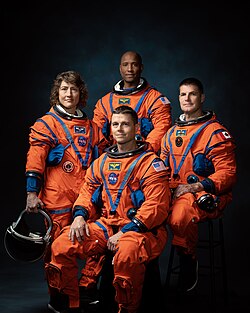
- 1 April – Artemis program: NASA[64] launches the Artemis II lunar flyby mission from Launch Complex 39B at the Kennedy Space Center in Florida, the first crewed flight beyond low Earth orbit since Apollo 17 in 1972. With a crew of four astronauts – Reid Wiseman (Commander) Victor Glover (Pilot), Christina Koch (Mission specialist), and Canadian astronaut Jeremy Hansen (Mission specialist)[65] – it also becomes the first time a person of color, a woman, and a non-United States citizen have left low Earth orbit.[66] It will pass around the Moon's far side on April 6.
Scheduled events
[edit]See also
[edit]References
[edit]- ^ Liu, Jiaxing; Zhu, Ping; Escande, Dominique Franck; Liu, Wenbin; Xue, Shiwei; Lin, Xin; Tang, Panjun; Wang, Liang; Yan, Ning; Yang, Jinju; Duan, Yanmin; Jia, Kai; Wu, Zhenwei; Cheng, Yunxin; Zhang, Ling (1 January 2026). "Accessing the density-free regime with ECRH-assisted ohmic start-up on EAST". Science Advances. 12 (1) eadz3040. doi:10.1126/sciadv.adz3040. ISSN 2375-2548. PMC 12757026. PMID 41477826.
- ^ Mishra, Prabhat Ranjan (1 January 2026). "China's EAST Tokamak achieves stable operation at densities beyond limits". Interesting Engineering. Retrieved 8 January 2026.
- ^ Gunawan, Oki; Kim, Chaeyoun; Nainggolan, Bonfilio; Lee, Minyeul; Shin, Jonghwa; Kim, Dong Suk; Jo, Yimhyun; Kim, Minjin; Euvrard, Julie; Bishop, Douglas; Libsch, Frank; Todorov, Teodor; Kim, Yunna; Shin, Byungha (1 January 2026). "Electronic trap detection with carrier-resolved photo-Hall effect". Science Advances. 12 (1) eadz0460. doi:10.1126/sciadv.adz0460. ISSN 2375-2548. PMC 12757034. PMID 41477857.
- ^ Malayil, Jijo (14 January 2026). "New test detects defects in solar cells with 1,000 times sensitivity". Interesting Engineering. Retrieved 16 January 2026.
- ^ Kersten, Wenzel; de Zordo, Nikolaus; Diekmann, Oliver; Redchenko, Elena S.; Kanagin, Andrew N.; Angerer, Andreas; Munro, William J.; Nemoto, Kae; Mazets, Igor E.; Rotter, Stefan; Pohl, Thomas; Schmiedmayer, Jörg (2 January 2026). "Self-induced superradiant masing". Nature Physics. 22 (1): 158–163. arXiv:2402.08537. Bibcode:2026NatPh..22..158K. doi:10.1038/s41567-025-03123-0. ISSN 1745-2473. PMID 41550618.
- ^ Paleja, Ameya (2 January 2026). "First self-powered quantum microwave signal achieved in experiment". Interesting Engineering. Retrieved 4 January 2026.
- ^ "Calendar". Secretary-General's Scientific Advisory Board. Retrieved 31 December 2025.
- ^ "NASA Selects Tech Proposals to Advance Search-for-Life Mission". NASA. 5 January 2026. Retrieved 7 January 2026.
- ^ "NASA seeks to accelerate development of Habitable Worlds Observatory". Space News. 7 January 2026. Retrieved 7 January 2026.
- ^ "NSF–DOE Vera C. Rubin Observatory Spots Record-Breaking Asteroid in Pre-Survey Observations". Vera C. Rubin Observatory. 7 January 2026. Retrieved 11 January 2026.
- ^ "Global Climate Highlights 2025". copernicus.eu. 14 January 2026. Retrieved 14 January 2026.
- ^ Kristina Killgrove (14 January 2026). "Most complete Homo habilis skeleton ever found dates to more than 2 million years ago and retains 'Lucy'-like features". Live Science. Retrieved 30 January 2026.
- ^ Grine, Frederick E.; Yang, Deming; Hammond, Ashley S.; Jungers, William L.; Lague, Michael R.; Mongle, Carrie S.; Pearson, Osbjorn M.; Leakey, Meave G.; Leakey, Louise N. (2026). "New partial skeleton of Homo habilis from the upper Burgi Member, Koobi Fora Formation, Ileret, Kenya". The Anatomical Record. n/a (n/a) ar.70100. doi:10.1002/ar.70100. ISSN 1932-8494. PMID 41527936.
- ^ Institute, Turkana Basin (28 April 2015). "Ancient Homo fossils discovered in Kenya | Turkana Basin Institute". Retrieved 30 January 2026.
- ^ D. M. Kirschbaum, L. Chen, D. A. Zocco, H. Hu, F. Mazza, M. Karlich, M. Lužnik, D. H. Nguyen, J. Larrea Jiménez, A. M. Strydom, D. Adroja, X. Yan, A. Prokofiev, Q. Si & S. Paschen (2026). "Emergent topological semimetal from quantum criticality". Nature Physics. Springer Nature: (published online 14 January 2026). doi:10.1038/s41567-025-03135-w. PMC 12904783.
{{cite journal}}: CS1 maint: multiple names: authors list (link) - ^ Yi, Difan; Liu, Qian; Chen, Shi; Dong, Chunlai; Feng, Huanbo; Gao, Chaosong; Huang, Wenqian; Jing, Xinmei; Kong, Lingquan; Li, Jin; Li, Peirong; Liang, Enwei; Ma, Ruiting; Su, Chenguang; Su, Liangliang (15 January 2026). "Direct observation of the Migdal effect induced by neutron bombardment". Nature. 649 (8097): 580–583. Bibcode:2026Natur.649..580Y. doi:10.1038/s41586-025-09918-8. ISSN 0028-0836.
- ^ Nuo, Xu (16 January 2026). "New finding to help probe dark matter". global.chinadaily.com.cn. Retrieved 16 January 2026.
- ^ Communication, N. B. I. (15 January 2026). "Copenhagen researchers make the front page of Nature: Solving the mystery of the universe's 'little red dots'". nbi.ku.dk. Retrieved 15 January 2026.
- ^ Rusakov, V.; Watson, D.; Nikopoulos, G. P.; Brammer, G.; Gottumukkala, R.; Harvey, T.; Heintz, K. E.; Damgaard, R.; Sim, S. A.; Sneppen, A.; Vijayan, A. P.; Adams, N.; Austin, D.; Conselice, C. J.; Goolsby, C. M. (2026). "Little red dots as young supermassive black holes in dense ionized cocoons". Nature. 649 (8097): 574–579. Bibcode:2026Natur.649..574R. doi:10.1038/s41586-025-09900-4. ISSN 1476-4687. PMC 12804088. PMID 41535486.
- ^ "Ice from Swiss glacier is safely stored in Antarctica". blue News. Retrieved 14 January 2026.
- ^ "Antarctica ice sanctuary launched to preserve the cores of dying glaciers". Yahoo News. 14 January 2026. Retrieved 14 January 2026.
- ^ "Schneehöhle als Klima-Archiv der Erde: Erste Eisbohrkerne in Antarktis-Lagerstätte". stern.de (in German). 14 January 2026. Retrieved 14 January 2026.
- ^ Stocker, Thomas (14 January 2026). "La première bibliothèque de carottes glaciaires en Antarctique pour protéger la mémoire climatique de l'humanité". The Conversation. Retrieved 14 January 2026.
- ^ "Antartide: nasce archivio mondiale ghiaccio con primi campioni da Alpi - Borsa Italiana". www.borsaitaliana.it. Retrieved 14 January 2026.
- ^ "A cow has been filmed using tools for the first time ever, stunning scientists". BBC Science Focus. 19 January 2026. Retrieved 21 January 2026.
- ^ Antonio, Mascaró; M.I. Auersperg, Alice (2026). "Flexible use of a multi-purpose tool by a cow". Current Biology. 36 (2): R44–R45. doi:10.1016/j.cub.2025.11.059. PMID 41558466.
- ^ Ahamed, Ahasan; Myat, Htet; Rawat, Amita; McPhillips, Lisa N.; Islam, M. Saif (19 January 2026). "AI-augmented photon-trapping spectrometer-on-a-chip on silicon platform with extended near-infrared sensitivity". Advanced Photonics. 8 (1). doi:10.1117/1.AP.8.1.016008. ISSN 2577-5421.
- ^ "AI-driven ultrafast spectrometer-on-a-chip: A revolution in real-time sensing". EurekAlert!. 20 January 2026. Retrieved 21 January 2026.
- ^ "New insights into the origins of the chemistry of life". www.mpg.de. Retrieved 7 February 2026.
- ^ Araki, Mitsunori; Sanz-Novo, Miguel; Endres, Christian P.; Caselli, Paola; Rivilla, Víctor M.; Jiménez-Serra, Izaskun; Colzi, Laura; Zeng, Shaoshan; Megías, Andrés; López-Gallifa, Álvaro; Martínez-Henares, Antonio; San Andrés, David; Martín, Sergio; Requena-Torres, Miguel A.; García de la Concepción, Juan (23 January 2026). "A detection of sulfur-bearing cyclic hydrocarbons in space". Nature Astronomy: 1–9. arXiv:2511.23299. doi:10.1038/s41550-025-02749-7. ISSN 2397-3366.
- ^ "Chile cancels energy project threatening astronomy - Prensa Latina". 24 January 2026. Retrieved 27 January 2026.
- ^ "Controversial Chilean energy project scrapped, relieving astronomers". www.science.org. Retrieved 27 January 2026.
- ^ Thompson, Mark (28 January 2026). "Chile's Paranal Observatory Saved from Industrial Development". Universe Today. Retrieved 29 January 2026.
- ^ Venner, Alexander; Vanderburg, Andrew; Huang, Chelsea X.; Dholakia, Shishir; Schwengeler, Hans Martin; Howell, Steve B.; Wittenmyer, Robert A.; Kristiansen, Martti H.; Omohundro, Mark; Terentev, Ivan A. (2026). "A Cool Earth-sized Planet Candidate Transiting a Tenth Magnitude K-dwarf from K2". The Astrophysical Journal Letters. 997 (2): L38. arXiv:2601.19870. doi:10.3847/2041-8213/adf06f.
- ^ Lu, Donna (29 January 2026). "A potentially habitable new planet has been discovered 146 light-years away – but it may be -70C". The Guardian. ISSN 0261-3077. Retrieved 29 January 2026.
- ^ "AI model from Google DeepMind reads recipe for life in our DNA". BBC News. 28 January 2026. Retrieved 28 January 2026.
- ^ "Advancing regulatory variant effect prediction with AlphaGenome". Nature. 28 January 2026. Retrieved 7 February 2026.
- ^ "Cheops discovers late bloomer from another era". www.esa.int. Retrieved 12 February 2026.
- ^ Voices, EarthSky (12 February 2026). "Inside out planetary system upends notions of formation". earthsky.org. Retrieved 12 February 2026.
- ^ Wilson, Thomas G.; Simpson, Anna M.; Collier Cameron, Andrew; Cloutier, Ryan; Adibekyan, Vardan; John, Ancy Anna; Alibert, Yann; Stalport, Manu; Egger, Jo Ann; Bonfanti, Andrea; Billot, Nicolas; Guterman, Pascal; Maxted, Pierre F. L.; Simon, Attila E.; Sousa, Sérgio G. (2026). "Gas-depleted planet formation occurred in the four-planet system around the red dwarf LHS 1903". Science. 0 (0) eadl2348. arXiv:2602.11271. doi:10.1126/science.adl2348.
- ^ Chatterjee, Sourav; Tan, Jonathan C. (11 December 2013). "INSIDE-OUT PLANET FORMATION". The Astrophysical Journal. 780 (1): 53. arXiv:1306.0576. doi:10.1088/0004-637X/780/1/53. ISSN 0004-637X.
- ^ Gianni, Edoardo; Kwok, Samantha L. Y.; Wan, Christopher J. K.; Goeij, Kevin; Clifton, Bryce E.; Colizzi, Enrico S.; Attwater, James; Holliger, Philipp (12 February 2026). "A small polymerase ribozyme that can synthesize itself and its complementary strand". Science. doi:10.1126/science.adt2760. ISSN 0036-8075.
- ^ Boosting origin of life theory, RNA comes close to copying itself (Report). 12 February 2026. doi:10.1126/science.zddu0t3.
- ^ "Breaking encryption with a quantum computer just got 10 times easier". New Scientist. 25 February 2026. Retrieved 25 February 2026.
- ^ "The Pinnacle Architecture: Reducing the cost of breaking RSA-2048 to 100 000 physical qubits using quantum LDPC codes". arXiv. 12 February 2026. Retrieved 25 February 2026.
- ^ "Centenarians' blood sheds light on the mechanisms of longevity". University of Geneva. 24 February 2026. Retrieved 25 February 2026.
- ^ "Rising carbon dioxide levels now detected in human blood". Phys.org. 27 February 2026. Retrieved 28 February 2026.
- ^ "Carbon dioxide overload, detected in human blood, suggests a potentially toxic atmosphere within 50 years". Springer Nature. 26 February 2026. Retrieved 28 February 2026.
- ^ "Astronomers confirm potentially habitable exoplanet in the solar neighborhood". Astronomy. 6 March 2026. Retrieved 18 March 2026.
- ^ "Surgeon's op on patient 1,500 miles away a UK first". BBC News. BBC. 6 March 2026. Retrieved 6 March 2026.
- ^ "In a first, researchers confirm global warming has accelerated in last decade". American Geophysical Union. 9 March 2026. Retrieved 17 March 2026.
- ^ "Centuries of net-negative emissions required to secure a safe climate future". International Institute for Applied Systems Analysis. International Institute for Applied Systems Analysis. 11 March 2026. Retrieved 12 March 2026.
- ^ "UW astronomers collect rare evidence of two planets colliding". University of Washington. 11 March 2026. Retrieved 15 March 2026.
- ^ "Breakthrough in blocking killer 'spike' growth that destroys lithium batteries". New Atlast. 13 March 2026. Retrieved 14 March 2026.
- ^ "Particle discovered at CERN solves a 20-year-old mystery". New Scientist. 17 March 2026. Retrieved 18 March 2026.
- ^ "LHCb Collaboration discovers new proton-like particle". CERN. 17 March 2026. Retrieved 18 March 2026.
- ^ Quantum pioneers win Turing Award for encryption breakthrough
- ^ "Engineered tissue offers hope for children born with 'missing' food pipe". EurekAlert!. 20 March 2026. Retrieved 20 March 2026.
- ^ "First lab-grown oesophagus successfully implanted in pigs". Sky News. 20 March 2026. Retrieved 20 March 2026.
- ^ "World first: antimatter particles transported in Geneva". SwissInfo.ch. 24 March 2026. Retrieved 24 March 2026.
- ^ "Please drive carefully: scientists plan to transport volatile antimatter for first time". The Guardian. 14 March 2026. Retrieved 24 March 2026.
- ^ "Project Hail Mary meets reality: 45 planets could harbor alien life". ScienceDaily. 25 March 2026. Retrieved 25 March 2026.
- ^ "Scientists uncovered the nutrients bees were missing — Colonies surged 15-fold". ScienceDaily. 27 March 2026. Retrieved 27 March 2026.
- ^ Diebelius, Georgia; Hanlon, Tim; Blackshaw, Ethan; Nunes, Eliana; Anders, Tannur (2 April 2026). "NASA launches Artemis 2 mission with astronauts on their way to Moon". The Mirror. Retrieved 2 April 2026.
- ^ "Our Artemis Crew - NASA". Retrieved 2 April 2026.
- ^ "Artemis II 2026: NASA prepares first crewed mission to circle around the moon in 50 years, scheduled for February". The Times of India. 25 September 2025. ISSN 0971-8257. Retrieved 31 December 2025.
External links
[edit] Media related to 2026 in science at Wikimedia Commons


